English has more than one way to talk about the future, and two of the most common are will and going to. Many learners use them as if they mean exactly the same thing, but there are important differences. In this lesson, you’ll learn the difference between will and going to, how to form them, and when to use each one.
Will vs. Going To
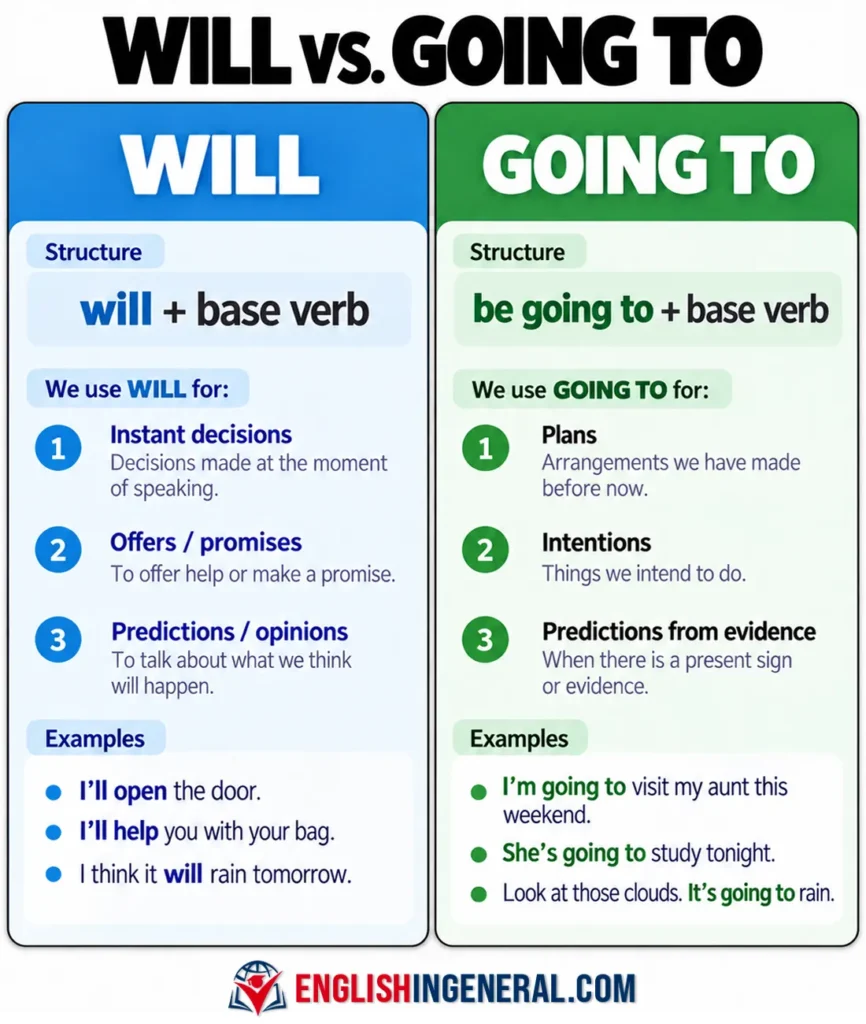
Both will and going to are used to talk about the future, but in different situations. We use will for decisions made at the moment of speaking and going to for plans or intentions decided earlier. For predictions, will is usually based on an opinion or belief, while going to is based on present evidence.
| Situation | Will | Going To |
|---|---|---|
| Decision | Made at the moment | Already planned |
| Prediction | Based on an opinion or belief | Based on present evidence |
How to Form Will and Going To
We use will + base verb to form sentences with will. With going to, we use am, is, or are + going to + base verb. In negative sentences, will not is usually shortened to won’t. In negative sentences, will not is usually shortened to won’t.
| Sentence Type | Will | Going To |
|---|---|---|
| Affirmative | She will call later. | She is going to call later. |
| Negative | She won’t call later. | She isn’t going to call later. |
| Question | Will she call later? | Is she going to call later? |
When to Use Will
We use will to talk about several types of future situations, including decisions made at the moment, predictions, future facts, promises, and offers.
Decisions made at the moment
- The phone is ringing. I’ll answer it.
- I’m thirsty. I’ll get some water.
Predictions based on opinions or beliefs
- I think she will pass the exam.
- It will probably be busy tomorrow.
Promises
- I will call you when I arrive.
- I won’t tell anyone your secret.
Offers
- I will help you with those bags.
- I will carry that box for you.
When to Use Going To
We use going to for future plans or intentions that have already been decided before the moment of speaking. We also use it for predictions when there is clear evidence in the present.
Plans and intentions
- We are going to move next month.
- She is going to study medicine at university.
Predictions based on present evidence
- Look at those clouds. It is going to rain.
- Be careful! You are going to drop that glass.