In English, we can describe the same action in two different ways. We can focus on who does the action, or on the person or thing that receives it. This second way is called the passive voice.
In this lesson, you’ll learn the difference between active and passive voice, how to form the passive, when to use it, and how to use by to show who performs the action.
Active vs Passive Voice
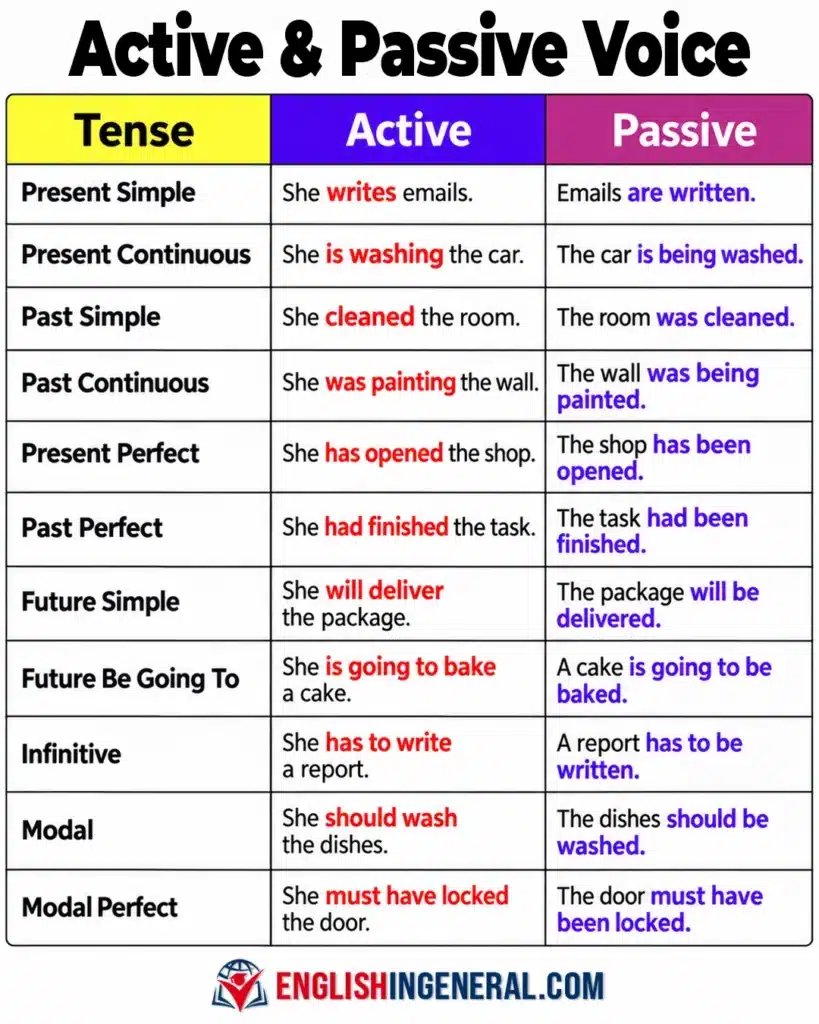
In the active voice, the subject performs the action. In the passive voice, the subject receives or is affected by the action. The basic meaning usually stays the same, but the focus changes. The table below shows how active sentences change into the passive.
| Tense | Active Voice | Passive Voice |
|---|---|---|
| Present Simple | They clean the rooms. | The rooms are cleaned. |
| Present Continuous | They are painting the house. | The house is being painted. |
| Past Simple | She wrote the report. | The report was written. |
| Past Continuous | They were repairing the road. | The road was being repaired. |
| Present Perfect | They have finished the work. | The work has been finished. |
| Past Perfect | They had sent the email. | The email had been sent. |
| Future with will | They will announce the results. | The results will be announced. |
| Be going to | They are going to build a bridge. | A bridge is going to be built. |
| Infinitive | We need to finish the work. | The work needs to be finished. |
| Modal Verb | You must wear a helmet. | A helmet must be worn. |
| Modal Perfect | They should have finished the work. | The work should have been finished. |
How to Form the Passive Voice
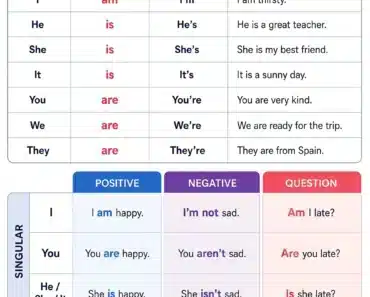
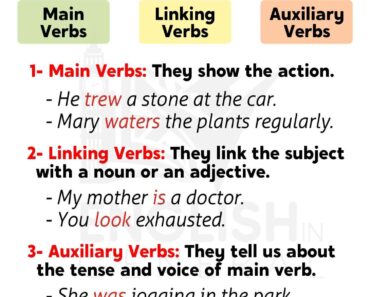
We form the passive voice with the verb be and the past participle of the main verb. When an active sentence becomes passive, the object becomes the subject. The form of be changes with the tense, while the main verb stays in the past participle form.
subject + be + past participle
Active: The mechanic repaired the car.
Passive: The car was repaired by the mechanic.
| Tense | Passive Structure | Example |
|---|---|---|
| Present Simple | am / is / are + past participle | The rooms are cleaned every day. |
| Present Continuous | am / is / are being + past participle | The house is being painted. |
| Past Simple | was / were + past participle | The report was written yesterday. |
| Past Continuous | was / were being + past participle | The road was being repaired. |
| Present Perfect | has / have been + past participle | The work has been finished. |
| Past Perfect | had been + past participle | The email had been sent. |
| Future with will | will be + past participle | The results will be announced. |
| Be going to | am / is / are going to be + past participle | A bridge is going to be built. |
| Infinitive | to be + past participle | The car needs to be fixed. |
| Modal Verb | modal + be + past participle | A helmet must be worn. |
| Modal Perfect | modal + have been + past participle | The work should have been finished. |
When to Use the Passive Voice
We use the passive voice when the action or result is more important than who or what performs it. It is especially common in the following situations:
When the person who performs the action is unknown
- My phone was stolen yesterday.
- The window was broken last night.
When the person who performs the action is not important
- The streets are cleaned every morning.
- The documents were sent this morning.
When the person who performs the action is obvious from the context
- The suspect was arrested yesterday.
- The patient was taken to hospital.
When we want to focus on the action, result, or process
- The samples were tested in a laboratory.
- The mixture is heated for ten minutes.
Passive Voice with “By”
In a passive sentence, we use by to say who or what performs the action. The person or thing after by is called the agent.
- The novel was written by George Orwell.
- The building was designed by a local architect.
- The damage was caused by strong winds.
We often leave out by + agent when the person or thing that performs the action is unknown, obvious, or not important.
- My phone was stolen yesterday.
- The road was closed for several hours.
- English is spoken in many countries.