There is and there are are common structures used to say that someone or something exists or is present. The form we use depends on whether the noun is singular, plural, or uncountable. In this lesson, you’ll learn how to use there is and there are in affirmative sentences, negatives, and questions.
There Is and There Are
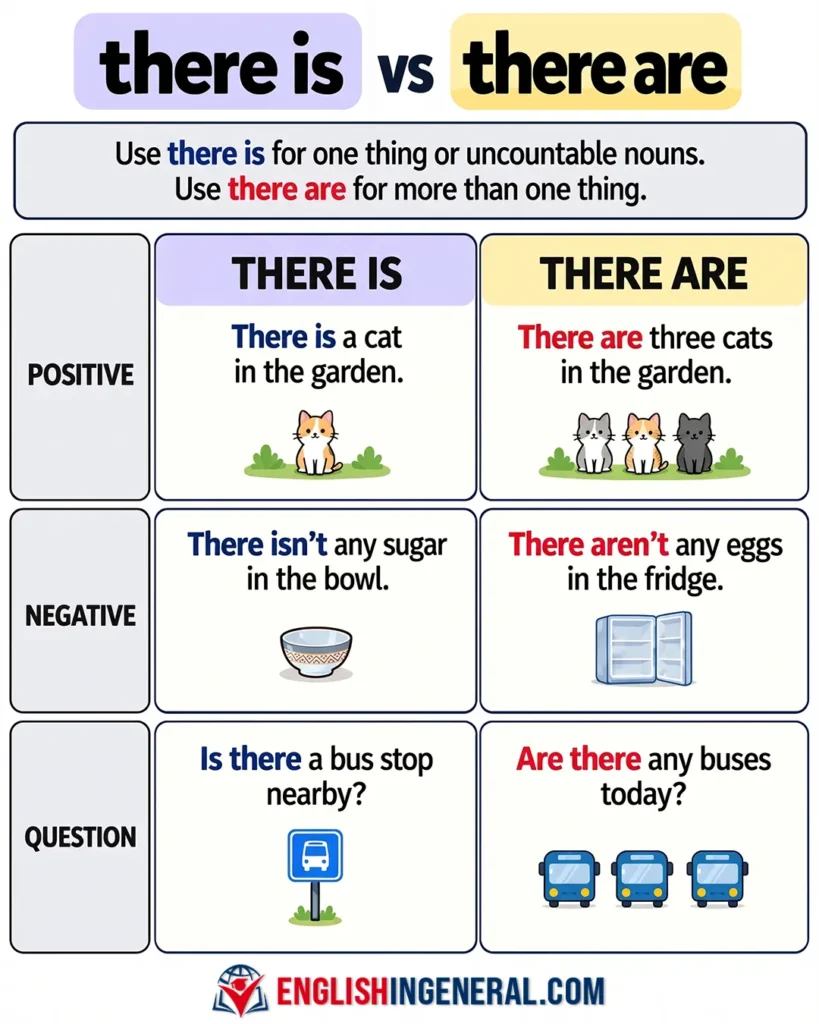
We use there is with singular countable nouns and uncountable nouns, and there are with plural countable nouns. In simple terms, use there is for one person or thing or for something we cannot usually count, and use there are for more than one person or thing.
Examples:
- There is a supermarket near my house.
- There is some water in the bottle.
- There are several restaurants near the hotel.
Affirmative Sentences
In affirmative sentences, use there is with singular and uncountable nouns, and there are with plural nouns. There is is often shortened to there’s in everyday English.
Examples:
- There is a new student in our class.
- There’s some food left in the kitchen.
- There are five bedrooms in the house.
Negative Sentences
To make negative sentences, we add not after is or are. The common contracted forms are there isn’t and there aren’t. We often use any with plural and uncountable nouns.
Examples:
- There isn’t a bus stop near my house.
- There isn’t any coffee left.
- There aren’t any empty seats on the train.
Questions
To make questions, put is or are before there. Use Is there…? with singular and uncountable nouns, and Are there…? with plural nouns.
Examples:
- Is there a bank near here?
- Is there any milk in the fridge?
- Are there any good cafés near the hotel?
We can answer these questions with short answers. In positive short answers, we use there is or there are, not there’s.
- Is there a supermarket nearby? → Yes, there is.
- Is there any food left? → No, there isn’t.
- Are there any tickets available? → Yes, there are.
- Are there any problems? → No, there aren’t.