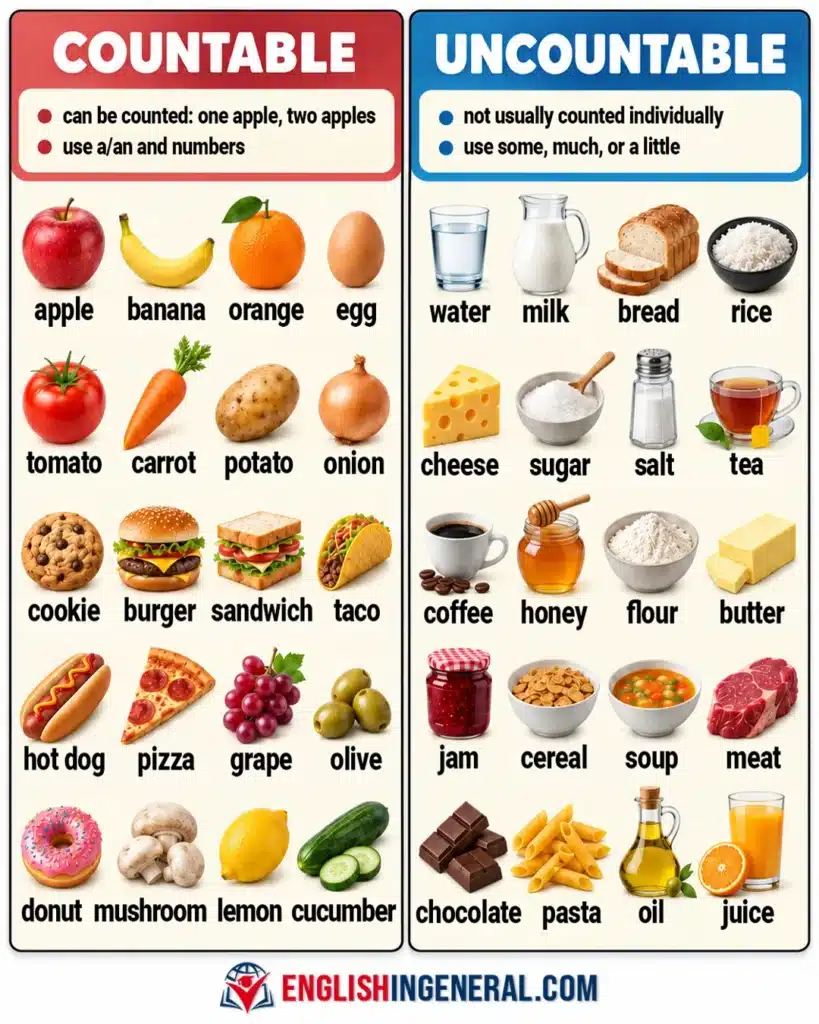
In English, nouns are divided into two main groups: nouns we can count and nouns we can’t. This difference affects the grammar around the noun, including the words we use before it. In this lesson, you’ll learn how countable and uncountable nouns work, which nouns can be both, and how to use quantity expressions with each type.
Countable Nouns
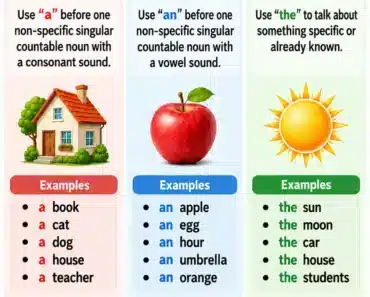
Countable nouns are nouns that we can count as separate people, things, places, or ideas. They have singular and plural forms. A singular countable noun usually needs a determiner such as a/an, the, my, or this, while plural countable nouns can be used with numbers. Plural forms can be regular or irregular.
| Singular | Plural | Example |
|---|---|---|
| a book | two books | I bought a new book yesterday. |
| an apple | three apples | She bought three apples. |
| a child | four children | Four children were playing outside. |
| a woman | five women | Five women joined the class. |
Uncountable Nouns
Uncountable nouns are nouns that we do not normally count as separate items. They often refer to substances, materials, abstract ideas, or things considered as a whole. They usually have no plural form, are not used with a/an, and normally take a singular verb. Common examples include water, rice, bread, money, information, advice, furniture, luggage, and homework.
| Uncountable Noun | Example |
|---|---|
| information | We need some information about the course. |
| water | There is some water in the bottle. |
| advice | Her advice is always helpful. |
| furniture | The furniture is very expensive. |
We do not normally say an advice, two informations, or three furnitures. To express an exact quantity, we use expressions such as a piece of advice, two pieces of information, or three items of furniture.
Nouns That Can Be Countable and Uncountable
Some nouns can be countable or uncountable depending on their meaning. The uncountable form often refers to a substance, material, or general idea, while the countable form usually refers to an individual item, serving, or experience.
| Noun | Uncountable | Countable |
|---|---|---|
| chicken | We had chicken for dinner. | There are three chickens outside. |
| coffee | I drink coffee every morning. | We ordered two coffees. |
| glass | The table is made of glass. | I need two glasses. |
| paper | I need some paper. | She wrote two papers for the course. |
| hair | She has long hair. | I found a hair on my jacket. |
| experience | She has a lot of experience. | It was an amazing experience. |
| time | I don’t have much time today. | We had a great time at the party. |
| room | There isn’t much room in the car. | The house has four rooms. |
Quantifiers with Countable and Uncountable Nouns
We use quantifiers to talk about the number or amount of something. Some quantifiers are used with countable nouns, some with uncountable nouns, and some can be used with both.
| Countable Nouns | Uncountable Nouns | Both |
|---|---|---|
| many | much | some |
| a few | a little | any |
| few | little | a lot of |
| several | — | lots of |
| — | — | enough |
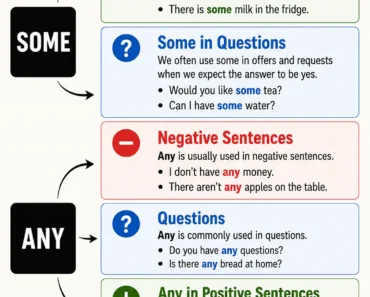
Many and much are especially common in questions and negative sentences, while a lot of and lots of are very common in positive sentences. Some is usually used in positive sentences, while any is common in questions and negatives. A few and a little mean “some”, while few and little mean “almost none”.
Examples:
- How many books have you read this year?
- We don’t have much time before the train leaves.
- I have a few questions about the new course.
- Add a little sugar if the tea is too bitter.
- There are few seats left near the front.
- We have little information about what happened.
- She bought some apples for the journey.
- We need some water before we leave.
- Are there any restaurants open nearby?
- Is there any milk left in the fridge?
- They have a lot of friends in the city.
- We have enough food for everyone at the party.
Quantity Expressions with Countable Nouns
Countable nouns can be grouped, arranged, or packaged using quantity expressions. These expressions are usually optional, but they give more specific information about how the items are grouped or presented. For example, ten flowers tells us the number, while a bunch of flowers shows that the flowers are together as a group.
| Quantity Expression | Example |
|---|---|
| a group of students | A group of students entered the museum. |
| a team of players | A team of players was waiting outside. |
| a bunch of flowers | He bought a bunch of flowers. |
| a row of houses | There is a row of houses along the road. |
| a line of cars | We saw a long line of cars. |
| a stack of books | There was a stack of books on the desk. |
| a box of chocolates | She received a box of chocolates. |
| a bag of apples | I bought a bag of apples. |
| a basket of eggs | We need a basket of eggs. |
Quantity Expressions with Uncountable Nouns
Because uncountable nouns are not normally counted directly, we use containers, measurements, and units to express a specific amount. The quantity expression itself can be counted, so we can say one bottle of water, two bottles of water, or three pieces of advice.
| Quantity Expression | Example |
|---|---|
| a cup of tea | I made a cup of tea. |
| a glass of milk | She drank a glass of milk. |
| a bottle of water | He bought a bottle of water. |
| a jar of jam | We opened a jar of jam. |
| a kilo of rice | I need a kilo of rice. |
| a litre of milk | We bought two litres of milk. |
| a gram of salt | Add a gram of salt. |
| a piece of advice | She gave me a piece of advice. |
| a slice of bread | I had two slices of bread. |
| a loaf of bread | We bought a loaf of bread. |
| a piece of information | I need one more piece of information. |
| an item of furniture | They bought three items of furniture. |