The verb “to be” is the heart of the English language. You use it to introduce yourself, describe people, talk about feelings, and much more. It’s usually the very first verb learners meet, and once you understand it well, everything else in English becomes easier. In this article, you’ll learn exactly how and when to use am, is, and are, with clear rules and simple examples.
What Is the Verb “To Be”?
The verb “to be” has three forms in the present tense:
- am
- is
- are
We use these forms to talk about people, things, feelings, jobs, places, ages, and more.
Examples:
- I am a teacher.
- She is happy.
- They are at school.
Am, Is and Are: Forms and Contractions
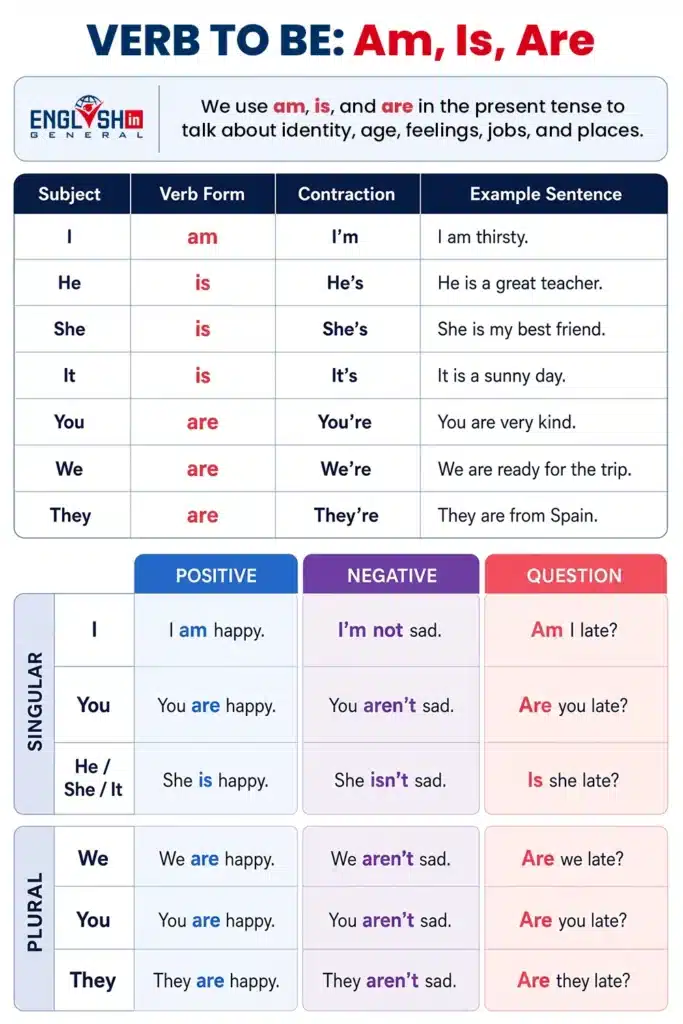
This table shows how “to be” changes with each subject pronoun, along with the short forms people use when speaking.
| Subject | Verb Form | Contraction | Example Sentence |
|---|---|---|---|
| I | am | I’m | I am thirsty. |
| He | is | He’s | He is a great teacher. |
| She | is | She’s | She is my best friend. |
| It | is | It’s | It is a sunny day. |
| You | are | You’re | You are very kind. |
| We | are | We’re | We are ready for the trip. |
| They | are | They’re | They are from Spain. |
In everyday speech, people often use the short form. You will hear “I’m tired” more often than “I am tired,” so it helps to feel comfortable with both.
When to Use “Am”
We use am only with the pronoun I.
Examples:
- I am from Turkey.
- I am 25 years old.
- I am tired today.
When to Use “Is”
We use is with singular subjects: he, she, it, and singular nouns (one person, animal, place, or thing).
Examples:
- He is a doctor.
- She is my sister.
- It is a sunny day.
- The book is on the table.
When to Use “Are”
We use are with you, we, they, and plural nouns (more than one person or thing).
Examples:
- You are very kind.
- We are ready.
- They are from Spain.
- The students are in the classroom.
We use are with you for both one person and more than one person. For example:
- You are my friend.
- You are my friends.
Negative Sentences with “To Be”
To make a negative sentence, add not after am, is, or are.
- I am not a student.
- She is not here.
- They are not ready.
We often shorten these into negative contractions too:
- is not → isn’t
- are not → aren’t
- am not → no contraction (we simply say I’m not)
Examples:
- He isn’t at home.
- We aren’t late.
Questions with “To Be”
To make a question with the verb to be, put am, is, or are before the subject.
- Am I late?
- Is she your friend?
- Are you hungry?
With the verb to be, we do not use do or does to make questions. We simply move am, is, or are before the subject.
Short Answers with “To Be”
In everyday English, we usually don’t repeat the whole sentence when answering a yes/no question. Instead, we use a short answer with the subject pronoun and am, is, or are.
Examples:
- Is she a doctor? → Yes, she is. / No, she isn’t.
- Are you ready? → Yes, I am. / No, I’m not.
- Are they from Spain? → Yes, they are. / No, they aren’t.
- Am I late? → Yes, you are. / No, you aren’t.
A quick note: In short answers, we don’t use contractions in positive answers. We say “Yes, she is,” not “Yes, she’s.” But we can use contractions in negative answers, like “No, she isn’t.”
Conclusion
The verb “to be” (am, is, are) is small, but it plays a huge role in everyday English. Once these three words start to feel natural, your sentences will become smoother and more confident. Keep the table above close by, practice a little each day, and soon you won’t even have to think about it. It will just feel natural.